
Road to the WTA Finals: Coco Gauff's Year — A Journey from Weakness to Weapon, or an Unfinished Story?
कोको गॉफ का 2026 सीज़न: 47-15 (75.8% जीत दर), सिनसिनाटी WTA 1000 खिताब, मियामी और रोम के फाइनल, तथा विंबलडन, यूएस ओपन, दुबई और टोरंटो के सेमीफाइनल — तीनों सतहों पर सात गहरे रन। WTA का दावा है कि उन्होंने सर्विस को हथियार बना लिया, लेकिन उपलब्ध आंकड़ों में सर्विस का एक ही आंकड़ा है: यूएस ओपन क्वार्टरफाइनल में 12 डबल फॉल्ट और 42 अनफोर्स्ड एरर। निष्कर्ष: दावा दिशात्मक रूप से संभव है, संख्यात्मक रूप से असिद्ध; वास्तविक तकनीकी प्रगति 'हथियारीकरण' नहीं, 'पुनर्संतुलन' है। WTA फाइनल्स में उनका करियर रिकॉर्ड पाँच प्रवेशों में 7-8 है (खिताब 2024), जो राउंड-रोबिन प्रारूप में धीमी शुरुआत और एरर-अस्थिरता के कारण चेतावनी संकेत है। अहम कारक: ग्रुप चरण में शुरुआती लय और ब्रेक पॉइंट पर सेकंड सर्विस की स्थिरता।
The WTA's official website, in its pre-tournament series 'Road to the WTA Finals', has framed Coco Gauff's 2026 season in a very tidy narrative: the year the American turned her biggest weakness — the serve — into her biggest weapon. The story is attractive. It is also published by the same tour that stages the season-ending championships next week, which makes it part of a promotional series rather than independent reporting. That does not make its factual data points false. It does mean the interpretive layer — the 'weapon' framing — is a house narrative, not an independent finding. And when you read that narrative against the very numbers the article supplies, a clear crack appears.
The claim on one side, the evidence on the other
The article contains exactly one hard serve statistic: 12 double faults in a US Open quarterfinal. No ace rate, no first-serve percentage, no first- and second-serve points won, no double-faults-per-match figure. A technical transformation of that magnitude cannot be proven or refuted on this evidence base. When you have one data point of this kind, and it is negative, the claim has to be downgraded to 'directionally plausible, quantitatively unproven'. That is the most important line of this entire analysis.
The reality is that the article's most quoted technical line rests on the one match that contradicts it. Winning a Grand Slam quarterfinal with 12 double faults and 42 unforced errors does not show that the serve has become a weapon. It shows that the serve remains volatile under pressure and had to be rescued — by elite defence, court coverage and competitive stubbornness. The article itself calls the same match the one that most embodied her resilient season, which is accurate. Then it attributes the whole season to the serve. Those are two different explanations, and the available data favours the second.
Cincinnati and New York: two different pictures in one year
If you want the real technical story, it is a rebalancing, not a weaponisation. In Cincinnati, Gauff dropped just one set across the entire week — a tournament in which the serve leaked minimally. The US Open quarterfinal was the opposite: won despite heavy leakage. The season's pattern is consistent with the serve having been raised from liability to neutral on good days, while still reverting under Grand Slam-level pressure. That is a materially weaker claim than the headline, and a far more useful one for forecasting the WTA Finals.
The most likely explanation is that the 2026 serve is bimodal: efficient in best-of-three, moderate-pressure weeks, and regression-prone in knockout Grand Slam settings. That is the signature of a rebuilt motion that is not yet fully grooved under fatigue. Note that the new technical element was put in place roughly twelve months before the 2026 US Open — and that double-fault clusters still return in big matches suggests the break-in period is not over.
The core identity has not changed, and probably should not
Gauff's style is elite counterpunching baseline tennis — world-class movement, court coverage and defensive capacity. Her scarcity comes from that, not from the serve. The tour's serve-first archetype, such as Jessica Pegula's flat, front-foot aggression, is not her identity and probably never will be. Tellingly, the article's own 'shot of the year' is not a serve: it is a full-court sprint to a short ball, followed by a backhand passing winner — a defence-to-attack transition point. That choice is itself an admission of where her competitive edge sits.
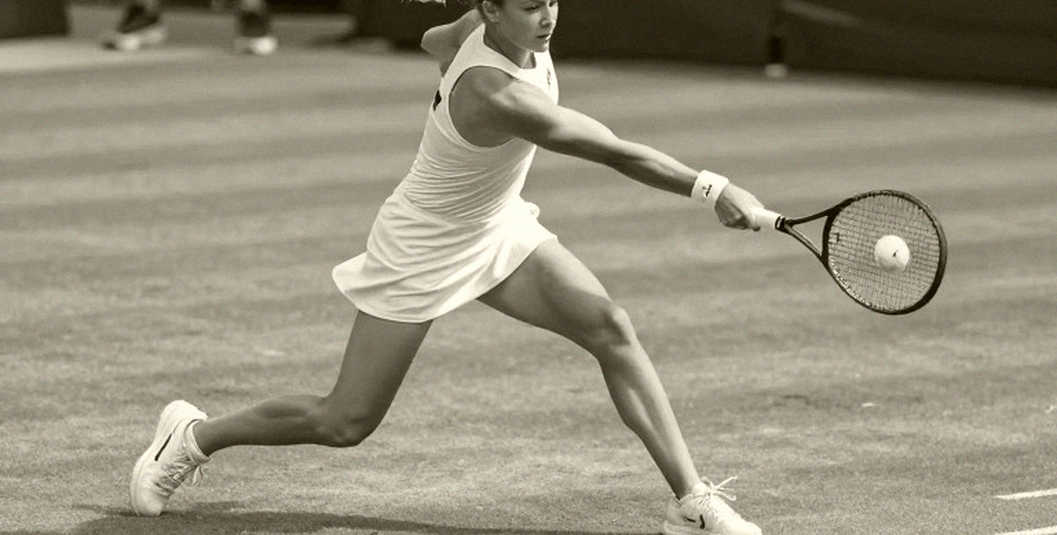
That is why chasing serve reconstruction at the expense of the movement-based game would be a strategic error. The correct read is that the rest of the package is top-3 level and the serve only needs to be average-plus. That is simultaneously her real limit and her real opportunity.
And now the numbers that actually matter
The season record is 47-15, a 75.8 per cent win rate — a top-5 band figure that stayed stable all year. But one title from three finals, and that too Cincinnati, tells a conversion story. The surface-by-surface picture confirms 2026 was genuinely all-surface: hard courts produced the Cincinnati title, the Miami final, the Dubai semifinal, the Toronto semifinal and the US Open semifinal; clay produced the Rome final; grass produced the Wimbledon semifinal. Seven deep runs spread across three surfaces. That is not a single-surface specialist profile; it is a versatility signal.
The clutch-point evidence is also on her side: two match points saved in a US Open quarterfinal tiebreak, and 12 come-from-behind wins across the season — tied for the tour lead with Jessica Pegula. But there is a subtle trap here: the same number can be generated by two different things — exceptional pressure tolerance, or chronic slow starts. The available data cannot separate them. And historically, players who lead the tour in comeback wins regress toward the mean the following season unless the underlying cause, whether second-serve vulnerability or slow starts, is fixed. If the cause is technical it can be improved; if it is temperamental, it is harder.
47 wins, one title: the classic consistent-but-not-closing profile
The shape of this season is a high floor and a capped ceiling. 62 matches, a 75.8 per cent win rate and seven deep runs at the top two tiers is title-contender-level consistency. One trophy from those seven opportunities is not. The question is whether the shortfall lies in the quality of the final-round opponent or in closing mechanics. One caveat is necessary here: the available analysis material does not include final scorelines, so the question stays open and should stay open. Filling what is unknown with inference is not reporting, it is promotion.
Another point runs through the article: its headline metric and its headline claim collide. It cites the 47-15 record and a fourth career WTA 1000 title as proof of a serve transformation. But a win rate is a whole-game metric, not a serve metric. Attributing a 47-15 season to one stroke, in the absence of that stroke's statistics, is an unsupported causal claim.
The ranking structure: healthy and broad
The points structure rests not on one tournament spike but on a broad, flat base: one WTA 1000 title, two WTA 1000 runner-up finishes, and four Grand Slam or WTA 1000 semifinals. That is the healthiest possible ranking composition for any player, because it absorbs a single early exit far better than a ranking built on a Grand Slam title. Gauff stayed inside the top 5 for most of the season, dropped out briefly after the clay swing and returned after the Wimbledon semifinal. The only ranking dip coincided with a surface transition, not a form collapse. This is a level-driven ranking, not a luck-driven one.
Looking ahead, one pressure window is clear: in 2027 she will have to defend the Cincinnati title, the Miami and Rome finals, and four semifinals — a heavy, diffuse defence load. But the 2026 WTA Finals is pure upside for her, because her title came in 2026, meaning no defending burden at this event.
The WTA Finals: history is a genuine caution flag
This is where the story turns. Across five WTA Finals appearances her career record is 7-8 — below her overall tour win rate. Do the simple arithmetic: if the 2026 title run supplied four or five of those seven wins, the other four appearances produced only two or three wins in total — a record materially weaker than her seeding would imply. The round-robin format punishes exactly the profile she has shown: slow starts and high unforced-error variance. Eight players, a group stage, then semifinals — and a maximum of 1,500 ranking points for an undefeated champion. The format allows three matches to find rhythm, but it also demands that you bring your best level from match one.
Even so, the form trajectory is rising, not flat. The Cincinnati title came after a title-less run through August — a late-season peak rather than a mid-season one. The US Open semifinal followed. Peaking in the final third of the season is the most favourable possible input for a year-end event. And a 62-match workload with deep runs on all three surfaces suggests her schedule was not light, which makes this late peak more remarkable and slightly counter-intuitive.
Hidden risks and a look ahead
Some things are not stated in the article but emerge from the signals. First, the quarterfinal won with 42 unforced errors indicates that the forehand remains the secondary pressure point; opponents who can extend rallies to that wing will still find yield. That inference carries low confidence because the available material contains no stroke-level data. Second, the second serve is probably still the shot opponents target on big points, because double faults cluster where break points cluster.
And one structural caution: Gauff's style can be troubled by first-strike players — serve-dominant opponents who shorten points and bypass her defence. The risk is logical, though not directly evidenced in the available material. There is no surface-specialisation bias here, and no visible mismatch between physical attributes and the demands of the style.
Conclusion
The season's story splits into two separate statements, and keeping them separate matters. First: Coco Gauff's 2026 season was excellent — 47-15, a permanent top-5 presence, seven deep runs across three surfaces, one WTA 1000 title. That claim is fully supported by the data. Second: she turned her serve into a weapon. That claim is not supported by the data, and the one statistic that exists points the other way. The first statement makes her a strong contender for the WTA Finals. The second rests that candidacy on a weak foundation.
The real question in the Finals will not be how big her serve is, but whether she can find rhythm early in the group stage, and whether the old habit of double-faulting under break-point pressure returns on the second serve. If she handles those two things, her package is enough to win the tournament. If not, a season of seven deep runs will end with another 'almost' — exactly the way her year has ended.